For first-time hosts, or even experienced cooks, the Thanksgiving turkey can be a nerve-wracking dish to prepare once a year. The USDA Food Safety and Inspection Service (FSIS) has some tips to reduce any anxiety over cooking your turkey this year.
Thawing Turkey Safely
There are two safe ways to thaw a turkey: in the refrigerator or in cold water. Thawing a frozen turkey on the kitchen counter, in hot water, or in the garage is not safe. Even though the center of the package may still be frozen, the outer layer of the food is in the Danger Zone between 40 and 140 degrees F — a temperature range where foodborne bacteria multiply rapidly. No matter which method you use, thawing a turkey takes time.
Cooking Turkey Safely
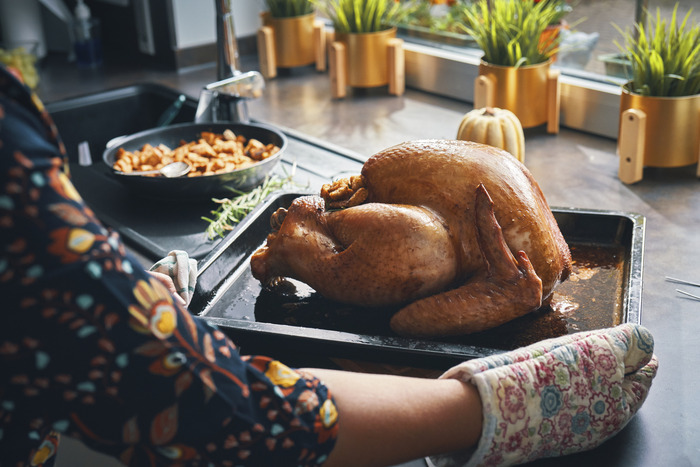
USDA also has helpful tips on cooking turkey based on your preferred cooking method. Regardless of how your turkey is cooked, insert a food thermometer into the thickest part of the breast, the innermost part of the wing and the innermost part of the thigh to check that its internal temperature at all three spots is at 165 degrees F.
Food Safety Specialists are Here for You – Even on Thanksgiving Day!
Need more information about Thanksgiving food safety? Call the USDA Meat and Poultry Hotline at 888-MPHotline (888-674-6854) , email MPHotline@usda.gov or chat live at ask.usda.gov from 10 a.m. to 6 p.m. ET, Monday through Friday to talk to a food safety specialist in English or Spanish. The Meat and Poultry Hotline will be open on Thanksgiving Day from 8 a.m. to 2 p.m. EST.
Access news releases and other information at USDA's Food Safety and Inspection Service's (FSIS) website at www.fsis.usda.gov/newsroom. Follow FSIS on X at @usdafoodsafety or in Spanish at X @usdafoodsafety_es and USDA on Instagram at @usdagov and Facebook.
USDA touches the lives of all Americans each day in so many positive ways. In the Biden-Harris Administration, USDA is transforming America's food system with a greater focus on more resilient local and regional food production, fairer markets for all producers, ensuring access to safe, healthy and nutritious food in all communities, building new markets and streams of income for farmers and producers using climate smart food and forestry practices, making historic investments in infrastructure and clean energy capabilities in rural America, and committing to equity across the Department by removing systemic barriers and building a workforce more representative of America. To learn more, visit www.usda.gov.
#
USDA is an equal opportunity provider, employer, and lender.





Comments
Post a Comment